Skip to content

05Global Classroom

Different perspectives. Shared investigation.

Groups in different countries take the same case file, investigate it inside their own media environment, then publish their reasoning — not a verdict.

01The idea

One case, four media environments

A story does not behave the same way everywhere. Comparing how it travelled is often more revealing than the story itself.
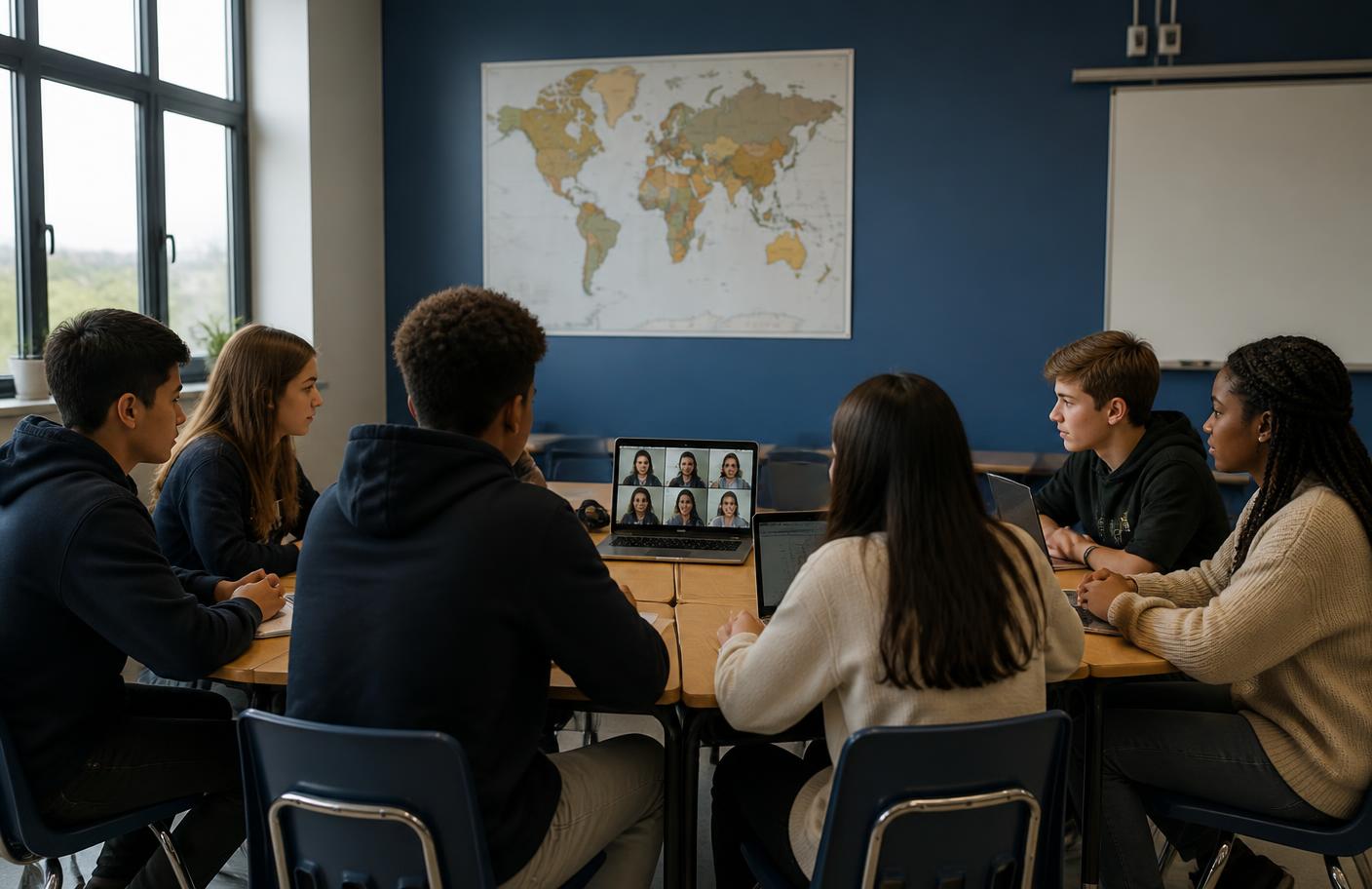
Students in a classroom joining a video call with groups in other countries, a world map on the wall behind them.
  1. 01

    A teacher opens a case

    A verified teacher creates a group and selects a case file. No student accounts are required to publish.

  2. 02

    Each group investigates locally

    The same evidence, checked against what each country's platforms and outlets actually showed.

  3. 03

    Reasoning is published, not verdicts

    Groups submit what they found, what evidence they used and what their context added.

  4. 04

    Groups compare

    Disagreements stay visible. Learning to argue from evidence is the point.

02The network

Who is investigating right now

Select a region to see what that group is working on. Sample activity for the prototype.

The Oppspot network, right now

8 regions · 41 groups Demo data

UNITED KINGDOMVIETNAMKENYAJAPANSWEDENPORTUGALAUSTRALIACHILE

Investigation

Case file 01 reopened by a sixth-form group

Manchester, United Kingdom

Eleven students re-checked the viral 'remote study ban' story and traced the earliest post to an account six weeks old.

24 investigations · 3 shared with Vietnam

03Submissions

Case file 01 — four readings

Every submission carries its evidence. No group is asked to declare a story true or false alone. Demo data

United Kingdom

Sixth-form group, Manchester

What we found
The earliest copy of the story came from an account created six weeks ago, not a newsroom.
Evidence we used
Archived post timestamps, the university's own announcements page.
Why we think it is misleading
No original publisher exists. What looked like reporting was circulation.
What our context added
Our national outlets ignored it entirely, which made the silence itself informative.

Vietnam

Media club, Hanoi

What we found
A translated version dropped the word 'two modules' and kept only 'remote study will end'.
Evidence we used
Side-by-side transcript of the original recording and three reposts.
Why we think it is misleading
Translation removed the limiting clause, so the claim grew as it travelled.
What our context added
Most of our classmates met the story inside a closed group chat, not on open platforms.

Kenya

Youth reporters, Nairobi

What we found
The protest photograph was already in circulation three years earlier, from a transport strike.
Evidence we used
Earlier published copies of the same photograph with different captions.
Why we think it is misleading
A real image with a false caption is the cheapest form of manipulation.
What our context added
We recognised the reuse pattern immediately — it is common in local election content.

Japan

Investigation club, Kyoto

What we found
The 92% figure came from a poll of 61 self-selected voters.
Evidence we used
Screenshot of the poll, published student numbers.
Why we think it is misleading
A percentage without a denominator is decoration, not data.
What our context added
Our group focused on the statistic because numbers carry unusual authority here.

04Recognition

Collaboration is the achievement

Points are earned for reaching primary sources and for working across borders — not for being first or loudest.
  • Cross-border investigation

    Findings compared with at least two other countries.

  • Translation check

    Traced how meaning changed between languages.

  • Primary source

    Reached the original recording or document.

  • Respectful disagreement

    Published a dissenting reading with its evidence.

Country-neutral

No single national curriculum is assumed; cases can be authored anywhere.

Multilingual by design

Cases and submissions are written to be translated, and translation loss is part of the lesson.

Group-level privacy

Groups publish as groups. No student profile data leaves the classroom.

Prototype scope: Global Classroom is a designed concept. Groups, submissions and activity shown here are demonstration content, not a live network.

Investigate case file 01 yourself